
Rain Man (1988)
Genre: Psychological Drama
Director: Barry Levinson
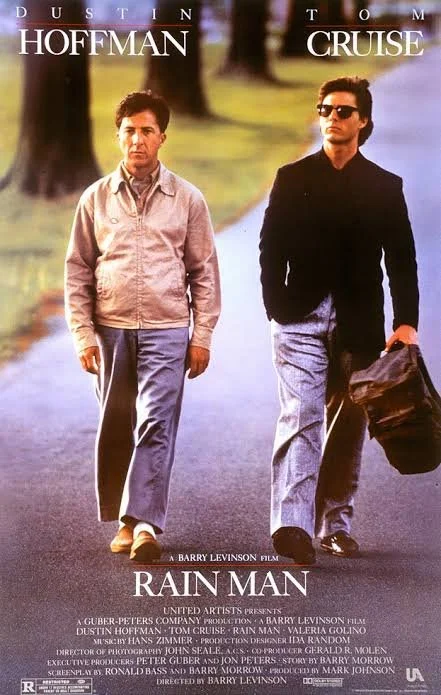
About this film:
After a selfish L.A. yuppie learns his estranged father left a fortune to an autistic-savant brother in Ohio that he didn't know existed, he absconds with his brother and sets out across the country, hoping to gain a larger inheritance.
One of the perks of working at Video Vision was that employees could take a few movies home after the store closed, as long as they brought them back the very next day. Every once in a while, I would notice a copy of a film that wasn’t supposed to be released to rent for another month or so. These copies were not for rent but instead part of a promotional package for an upcoming movie customers were looking forward to watch, along with posters, buttons,t-shirts, or sometimes a standee display. (My room was full of movie posters, Die Hard, Good Morning Vietnam, even an unopened Back To The Future that was sitting in his closet. SCORE!)
One Saturday in early June I took my boss’s mail to his office, and as he was going through it I noticed a package that looked about the size of a VHS tape.
“Is that a promotional movie, all by itself without any bells and whistles?”
“Yeah, Rain Man. Here, give it a look-see.”
The promotional cassettes video stores would receive didn’t have the normal box that we would display throughout the back of the store with 3x5 notecards in front of them, signalling that the movie is available. The cover box just gave the film’s title and a “not for rental or purchase” warning on the front, and on the back there would be a brief summary of the plot.
Rain Man is a film about Charlie Babbitt, played by Tom Cruise, who discovers that his estranged father has left a multimillion-dollar inheritance to his autistic brother, Raymond, portrayed by Dustin Hoffman. Charlie, unaware of Raymond’s existence, kidnaps him and embarks on a cross-country road trip with him. As they travel, they develop a deep bond, overcoming their differences and Charlie's initial resentment towards Raymond. The film explores themes of brotherly love, acceptance, and the complexities of autism, ultimately leading to Charlie’s realization of Raymond’s potential and his own growth.
Ms. Hall, my Psychology teacher, mentioned this film a few months ago in class when she was lecturing about “Pervasive Developmental Disorders” which included autism. Earlier in the 1980s autism was primarily described as a condition that could be confused with childhood schizophrenia. For me, if a teacher mentioned a movie in relation to whatever was being taught in class, I was way more engaged. I asked Ms. Hall if we could watch it in class if I could borrow it from my boss, without hesitation she agreed, apparently the last few weeks of school can be tedious for teachers too.
In 1989, watching Rain Man was just a fun distraction for me at the end of my senior year, a way to break up the monotony on a restless June afternoon in class. I remembered getting a kick out of the Vegas scene where Charlie got his brother Raymond to play Black Jack, counting cards from a six deck shoot. Traveling with Raymond was a lot of work for his brother, Raymond was set in his rituals and Charlie just wanted to get to California. Even though this film was a drama, the brothers’ journey created the perfect backdrop for many comedic moments, Raymond being the unaware “banana man” and Charlie the annoyed and frustrated “straight man”.
The film served its purpose, killing three days of class before graduation. I returned it to my boss and never gave Rain Man another thought. Needless to say, when I watched Rain Man again, some twenty-five years later, I had a very different perspective. Rain Man wasn’t just a movie to me anymore, it was an authentic depiction of the turmoil autism has on a family. I found it riveting, tragic and all too familiar.
I recommend Rain Man to everyone, especially those who are in an autism family. What I took from this film (during the ninth or tenth viewing) is that Rain Man is a story about limitations, particularly Charlie’s not Raymond’s. Charlie Babbitt (Tom Cruise) has a limited ability to love those in his life, and only sees things from his own point of view. He doesn’t seem to accept the dimensions of Raymond’s (Dustin Hoffman) world and grows frustrated at what looks like almost willful intractability. Eventually, toward the end of their journey, Charlie finds empathy and love for his brother, which involves accepting him exactly as he is. Charlie’s character arc evolves from a self-centered opportunist to a compassionate, caring brother. This growth could not have taken place without the discovery of a brother, that he never knew he had.
My Review:
Rain Man: Perspective Is Everything
In the spring of 1989, I was a senior at Cumberland Regional High School. (Go Colts!) The last few weeks of school that lead up to summer vacation have always been tedious for me, but when you add a healthy dose of ‘Senioritious” to that timeframe, the days move like cold molasses. At the time, I worked at Video Vision in the shopping mall at Carl’s Corner,where you could purchase washers and dryers, televisions, and rent VHS cassettes. Needless to say, Friday and Saturday evenings were especially busy.